Health »
Disease & Conditions »
Cancer » Prostate Cancer
Prostate Cancer
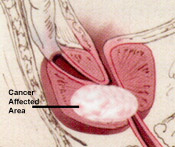 Prostate cancer is an abnormal, uncontrolled
growth of cells that results in the formation of a tumor in the prostate gland. Prostate, the walnut sized gland, is a part of the reproductive
system which lies deep in the pelvis. It is located in front of the rectum
and underneath the urinary bladder and surrounds the urethra, (the urine tube
running from the bladder, through the prostate and the penis). It contains gland
cells that produce some of the seminal fluid, which protects and nourishes sperm
cells in semen and supports the ejaculatory ducts, or sperm tubes. The prostate
continues to grow till a man reaches adulthood and is maintained after it reaches
normal size as long as male hormones are produced.
Prostate cancer is an abnormal, uncontrolled
growth of cells that results in the formation of a tumor in the prostate gland. Prostate, the walnut sized gland, is a part of the reproductive
system which lies deep in the pelvis. It is located in front of the rectum
and underneath the urinary bladder and surrounds the urethra, (the urine tube
running from the bladder, through the prostate and the penis). It contains gland
cells that produce some of the seminal fluid, which protects and nourishes sperm
cells in semen and supports the ejaculatory ducts, or sperm tubes. The prostate
continues to grow till a man reaches adulthood and is maintained after it reaches
normal size as long as male hormones are produced.
Prostate
cancer begins most often in the outer part of the prostate. It is the most common
cancer in men older than age 50. In most men, the cancer grows very slowly.
In fact, many men with the disease will never know they have the condition. Early
prostate cancer is confined to the prostate gland itself, and the majority of
patients with this type of cancer can live for years with no problems. In some
cases, it may spread from the prostate to nearby lymph nodes, bones or other organs.
This spread is called metastasis. Most Prostate cancers originate in the posterior
prostate gland, the rest originate near the urethra.
Prostate Cancer
Questions of
Questions & Answers |
|
| 1. |
Posted on :
16.1.2015 By : Mitali , Delhi
|
View Answer (0)
|
Post Answer
|
|
| |
My husband is suffer from blood cancer.. He had his first stage.. He took very expensive treatment by still he suffers a lot on his disease..... Is dis possible dat he can be became fit??? |
|
|
|
|
| 2. |
Posted on :
23.5.2013 By : Dharmendra Kumar Singh , Kolkata
|
View Answer (2)
|
Post Answer
|
|
| |
My nephew age 3+ has blood cancer 1st stage, please sugest me low budget hosital in Kolkata. |
|
|
| A1: |
The cheapest Hopital for Cancer treatment is Tata Medical at Rajarhat. It is the best in Eastern Region. |
| |
Posted By :Subho , kolkata | On 11.6.2013 |
|
| A2: |
There is a lot of cancer research is going on at tata cancer centre. You could try there. |
| |
Posted By :Admin , Kochi | On 23.5.2013 |
|
|
|
|
| 3. |
Posted on :
16.8.2012 By : Payalkelkar , Nagpur
|
View Answer (1)
|
Post Answer
|
|
| |
Suggest best treatment for blood cancer 1st stage, and best hosital in nagpur. |
|
|
|
|
|
|
| » more... |
Note : All statements given are only for information purpose. We are not responsible or liable for any problems related to the utilization of information on this site. We suggest that you consult a qualified doctor before trying any alternative health care remedies.



