Health »
Disease & Conditions »
Cancer » Cervical Cancer
Cervical Cancer
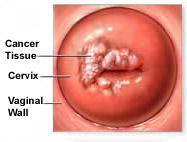 Cervical cancer
or cancer of the cervix is an abnormal growth of malignant (cancer) cells
in the cervix. It is the second most common cancer in females and it is successfully
curable in the early stages. Cervical cancer occurs most commonly between
40 and 55 years of age.
Cervical cancer
or cancer of the cervix is an abnormal growth of malignant (cancer) cells
in the cervix. It is the second most common cancer in females and it is successfully
curable in the early stages. Cervical cancer occurs most commonly between
40 and 55 years of age.
The cervix is the opening
of the uterus connected to the upper vagina. It is known as
the neck of the uterus. The lower end of the cervix has an opening called the
external os, and before childbirth it is about 5mm in diameter. It dilates to
10cm during labour to allow for childbirth and never regains its former
shape, changing to a slit approximately 7mm long. Normally the cervix is
pink in colour but turns bluish in pregnancy because of an increased blood supply.
The surface layer of the cervix is made up of two different
types of cells, flat cells called squamous cells and tall column-like gland
cells called columnar cells. This produces a mucous membrane, but the mucous
membrane of the cervix is smooth. The place where squamous and columnar cells
meet is known as the transformation zone and this is the area of the cervix where
cancer most commonly arises. The cancer cells may
be present in the cervix for 4-10 years before becoming invasive, affecting the
deeper tissues and giving rise to symptoms. Even when the cancer is invasive ,
there is an 80% chance of successful cure. Once it spreads through the pelvis
to the vagina, uterus, bladder or rectum, it is much more difficult to cure.
Questions of
Questions & Answers |
|
| 1. |
Posted on :
16.1.2015 By : Mitali , Delhi
|
View Answer (0)
|
Post Answer
|
|
| |
My husband is suffer from blood cancer.. He had his first stage.. He took very expensive treatment by still he suffers a lot on his disease..... Is dis possible dat he can be became fit??? |
|
|
|
|
| 2. |
Posted on :
23.5.2013 By : Dharmendra Kumar Singh , Kolkata
|
View Answer (2)
|
Post Answer
|
|
| |
My nephew age 3+ has blood cancer 1st stage, please sugest me low budget hosital in Kolkata. |
|
|
| A1: |
The cheapest Hopital for Cancer treatment is Tata Medical at Rajarhat. It is the best in Eastern Region. |
| |
Posted By :Subho , kolkata | On 11.6.2013 |
|
| A2: |
There is a lot of cancer research is going on at tata cancer centre. You could try there. |
| |
Posted By :Admin , Kochi | On 23.5.2013 |
|
|
|
|
| 3. |
Posted on :
16.8.2012 By : Payalkelkar , Nagpur
|
View Answer (1)
|
Post Answer
|
|
| |
Suggest best treatment for blood cancer 1st stage, and best hosital in nagpur. |
|
|
|
|
|
|
| » more... |
Note : All statements given are only for information purpose. We are not responsible or liable for any problems related to the utilization of information on this site. We suggest that you consult a qualified doctor before trying any alternative health care remedies.



