|
|

Monday, May 13, 2024
|
|


|
|||
Folk Art
 Folk
art is a higher form of culture in comparison to primitive art. The needs
and peculiar problems of the village people's life find an expression
in folk art. While satisfying the needs of the people, folk art attains
a certain aesthetic level. Folk art is divided into two classes, Viz.
Folk
art is a higher form of culture in comparison to primitive art. The needs
and peculiar problems of the village people's life find an expression
in folk art. While satisfying the needs of the people, folk art attains
a certain aesthetic level. Folk art is divided into two classes, Viz.
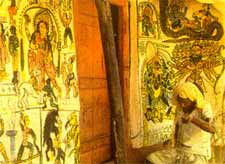
Folk art although dwindling, is still a living reality in Odisha (Orissa). Great skill is displayed in the making of dolls, toys, puppets, carvings on soapstone, wooden vessels, gate door ways, chests, palanquins, musical instruments, bridal costumes etc. Temple walls and walls of certain private houses are still painted. Drawing on canvas is still a practice in Odisha (Orissa). Odisha (Orissa)'s 'Patachitras' are famous in India and outside. Bowers of the pith flowers with figures of charming women are made on the occasion of 'Jhulana' (swinging festival of Radha and Krishna) on the full moon day of Shravana. Brass fishes, horn toys, filigree ornaments, a painted 'Farua' ( a temple-like wooden pot in which Vermilion is kept), textile and soapstone work and 'ganjapa' (traditional play card) of Odisha (Orissa) still draw wide attention. Palm leaf as a writing material is now out of use except on some ceremonial occasion. Some palm leaf manuscripts are carefully preserved in the museum at Bhubaneswar as specimens of traditional drawings and paintings.
Every woman in the village is more.jpg) or less acquainted with 'Chita' (painting on wall and floor with rice
paste). The floor is painted with the feet of the goddess Lakshmi and
the mud walls are decorated with paddy plants, finger-tips, birds,
lotus creepers etc on Thursdays in the month of Margashira. The south-facing
doors are decorated with paddy plants, ornaments, lotuses, Jagannath,
Balabhadra and Subhadra and cotton clinging on the turmeric paste and
worshipped on the occasion of the Sun moving southwards on the Samkranti
day of the month of Shravana.
or less acquainted with 'Chita' (painting on wall and floor with rice
paste). The floor is painted with the feet of the goddess Lakshmi and
the mud walls are decorated with paddy plants, finger-tips, birds,
lotus creepers etc on Thursdays in the month of Margashira. The south-facing
doors are decorated with paddy plants, ornaments, lotuses, Jagannath,
Balabhadra and Subhadra and cotton clinging on the turmeric paste and
worshipped on the occasion of the Sun moving southwards on the Samkranti
day of the month of Shravana.
%20craft.jpg) From
specimens of art now available like the baked terracotta horses with a
goddess under some big tree, the figure of the Puranic Brundabati bearing
the basil (Tulsi) plant on the head, painted wooden cover of a palm leaf
manuscript, cash boxes, utensils and pottery, we come to know how vividly
art was integrated with ancient Odisha (Orissa)n life.
From
specimens of art now available like the baked terracotta horses with a
goddess under some big tree, the figure of the Puranic Brundabati bearing
the basil (Tulsi) plant on the head, painted wooden cover of a palm leaf
manuscript, cash boxes, utensils and pottery, we come to know how vividly
art was integrated with ancient Odisha (Orissa)n life.
Folk art is produced primarily for the artist's own use. It is not commercialized. Women do thread embroidery, and make fans out of grass roots. They make use of home-made articles. Folk art has its own individuality and character and it exists by its intrinsic merit, i.e. flight of fancy of the artist, its symmetrical form, rhythm of design and efficient workmanship. Materials used in folk art are local and not imported from outside.


