|
|

Friday, August 21, 2026
|
|


|
||
|
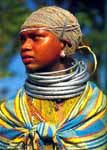
Most of the tribal people and much of the population in Odisha (Orissa) belong to the Australoid group in racial history, while most of the general population belong to the broad-headed Alpinoid type. Besides this, a sprinkling of Mediterranean type is found in the general population. Odisha (Orissa) had a high percentage of scheduled castes and tribes which together make 9.78 million. The scheduled tribes are concentrated in two belts. The northern belt comprises the district of Mayurbhanj, Keonjhar and Sundargarh. The southern belt consist of the district of Koraput, Ganjam and Phulbani. A large percentage of the tribal population in these districts have their own oral tribal languages and they do not know Oriya. The most important of these languages are Mundari, Santali, Saora and Kui / Kuvi. There are four cultural regions within the present boundaries of Odisha (Orissa). The north-eastern areas bordering on Bengal have been influenced in dress, food, habits, languages, social customs and festivities of Bengali culture and language. The southern parts of Ganjam and Koraput districts have a sizable Telugu-speaking population and have been influenced in language, food habits, dress and marriage customs by the Andhra culture and language. The western districts of Sambalpur, Bolangir and Kalahandi may be said in many ways to be a cultural and to some extent, linguistic continuum with the region of Chhatisgarh of Madhya Pradesh just belong the border where many Oriya-speaking castes live even at present. The fourth region may said to be the distinctive or typical or at least the tone-setting one, in both cultural institutions, social customs and linguistic and literary sophistication. This region comprises roughly the coastal districts of Balasore, Cuttack and Puri and portions of adjoining districts. Some of the tribes like the Kond and Saora have developed internal social differentiations along occupational specialisations as potters, weavers and basket makers. Some of these tribes like the Bhuiyan, the Bathudi, the Gond and the Binjhal (Binjhawar) of northern and western Odisha (Orissa) have been very much Hinduised.
|
|
|||||||||||||||||
|
|||||||||||||||||
Related Links |
| ▪ Classifieds |
| ▪ Education |
| ▪ Yellowpages |
| ▪ Photo Gallery |
| Last Updated on : 21 February 2026 |


 Since
prehistoric days the land of Odisha (Orissa) has been inhabited by various people.
The earliest settlers of Odisha (Orissa) were primitive hill tribes. Although prehistoric
communities cannot be identified, it is well known that Odisha (Orissa) had been
inhabited by tribes like Saora or Sabar from the Mahabharata days.
Since
prehistoric days the land of Odisha (Orissa) has been inhabited by various people.
The earliest settlers of Odisha (Orissa) were primitive hill tribes. Although prehistoric
communities cannot be identified, it is well known that Odisha (Orissa) had been
inhabited by tribes like Saora or Sabar from the Mahabharata days. (washer-man), the Kumbhar (potter),
the Chasa (farmer), the Tanti (weaver), the Keuta(flattened-rice-maker or fisherman),
the Barhai (carpenter), the Kamar (blacksmith), the Teli (oilman) and the Chamar
(shoemaker), Karana (writer), Guada (cattle keeper), Khandeita (Swordsman) and the
Paana (untouchable weaver). Each caste practically had its own cultural world
and
social milieu, with its peculiar festivals and rituals, its own tutelary deities
and sacred centres, its peculiar marriage, funeral and other customs, and its own
level and limitations of social interaction with members of other castes and
religious communities in the village society. These inter-caste relations were
usually limited to social necessities. Some cementing bonds were established
through a peculiar social institution called ritual Kinship and friendship (Mahapatra
1968).This institution ensured a semblance of social interaction between
the families of persons so related.
(washer-man), the Kumbhar (potter),
the Chasa (farmer), the Tanti (weaver), the Keuta(flattened-rice-maker or fisherman),
the Barhai (carpenter), the Kamar (blacksmith), the Teli (oilman) and the Chamar
(shoemaker), Karana (writer), Guada (cattle keeper), Khandeita (Swordsman) and the
Paana (untouchable weaver). Each caste practically had its own cultural world
and
social milieu, with its peculiar festivals and rituals, its own tutelary deities
and sacred centres, its peculiar marriage, funeral and other customs, and its own
level and limitations of social interaction with members of other castes and
religious communities in the village society. These inter-caste relations were
usually limited to social necessities. Some cementing bonds were established
through a peculiar social institution called ritual Kinship and friendship (Mahapatra
1968).This institution ensured a semblance of social interaction between
the families of persons so related.

