|
|

Tuesday, June 9, 2026
|
|


| INTRODUCTION DEVELOPMENT STAGE & PERFORMANCE TECHNIQUE CHARACTER TYPES MAKE UP TEXT COSTUME & ORNAMENT |
The facial make-up for Kathakali is so typical, elaborate and complex that it takes about four hours to wear and two to take it off. The artist who guides this make-up is an important person both at the training stage and also at the performing stage. He is known as Chouttikkaran. The dancer lies on his back on the floor while the make-up expert paints his face.
 Certain
colours are associated with particular moods and sentiments. Normally, light
green represents sringara, red raudra and yellow adbuta. Kathakali follows
these basic colour patterns. Its aim is not merely to cover the human
face, but rather to transform the actor into a god or a demon. Once the actor
has the make-up he is no longer himself, but has been transformed into the
character which he is playing. Even before his first stage entrance no one
Certain
colours are associated with particular moods and sentiments. Normally, light
green represents sringara, red raudra and yellow adbuta. Kathakali follows
these basic colour patterns. Its aim is not merely to cover the human
face, but rather to transform the actor into a god or a demon. Once the actor
has the make-up he is no longer himself, but has been transformed into the
character which he is playing. Even before his first stage entrance no one
If the characters are sattvika, the basic make-up is green, Pachcha. The cheeks up to the jaw-bone are covered with a light green paste and the eyes are elongated to give them a design which can be described as 'lotus-eyed'. The forehead has a white pigment and can take different designs depending upon the particular character. Thus Krishna has a different forehead design from that of Arjuna.
The jaw-bone is exaggerated by pasting along it cut-outs either of paper or of papier-mache, to give the face enlarged dimensions. With the costume, the make-up transforms the actor from his human proportions to superhuman stature. The make-up (Chutti) is a white paste made of ground-rice and lime and it is along the arc of this white paste that the cut of the false chin and jaw are struck.
When these characters assume the mood of ferocity (raudra), a large ferocious moustache in black is drawn on the basic green make-up along the upper lip reaching to the upper cheek-bone. The transformation of Bhima from the purely Pachcha character to the raudra Bhima is indicated in this manner.
When there are kings and heroes who could be described merely as villains or anti-heroes, but who may be described as rashasik characters such as Ravana, the basic green make-up is broken by red patches. Also, on the basic green make-up, an oval red and white design is made on the nose and on the upper cheek. The upturned moustache is common and a white blob of pith is attached to the nose which makes the characters seem more fantastic than human. This make-up is called Kathi. Demoniac characters also wear a pair of large canine teeth protruding out of the corners of their mouth, which further enhances their fierceness.
Antiheroes, villains, demons and
some special types in conventional Kathakali receive a make-up called the Tadis
(beard). Three types of beards are traditional - the red, the black and the
white. The red beard is for the evil character mostly involved in destructive
deeds. The basic colour scheme of the face is red, with upper portion of the
face painted back and the lower portion painted red. The eyes are not elongated
to take the lotus shape, but have a square patch of black collyrium giving them
a frightening look. The white paste (Chutti) is not ap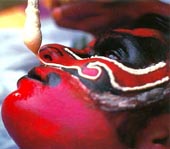 plied
along the natural contours of the jaw-bone. The paper cut-outs are also square
and put out from the line of the nose horizontally on either side of the face.
This together with the elongation of the chin by a flat false beard, gives these
characters a very ominous appearance. There are two fangs protruding from the
lips. With the screams and cries they utter, they succeed in creating an atmosphere
of the nether-world on the stage.
plied
along the natural contours of the jaw-bone. The paper cut-outs are also square
and put out from the line of the nose horizontally on either side of the face.
This together with the elongation of the chin by a flat false beard, gives these
characters a very ominous appearance. There are two fangs protruding from the
lips. With the screams and cries they utter, they succeed in creating an atmosphere
of the nether-world on the stage.
The black beards are different. These do not indicate the anti-heroes and the demons, but the aborigines and the off-beat characters like the Kirata (Siva disguised as hunter). The basic make-up here is not red but black. On this there are many fantastic designs in white and red. They also have crowns of peacock feathers. The female Ashuras like Surpanaka wear deep black on their faces with red on cheek-bones and the eyes elongated with black. This make-up is called Kari.
The white beard, known as veluppu tadi, indicates the third type of half-human gods like Hanuman. The basic make-up is white. These characters are benign, although they can assume ferocious forms. A different category of make-up is seen in characters like the Lion-God (Narasimha). The basic make-up of such characters is yellow, representing adbhuta or wonder. In the Kathakali tradition, this is known as a variation of the white beard. This make-up is one of the most effective make-ups of the Kathakali dance drama.
Minukku is the make-up worn by good female characters and the Sages, Sadhus, Brahmins and Rishies. It denotes the simplicity, piousness, spirituality, restraint and equipoise. In this golden yellowish and pink colours are used. The male characters wear jatamukta (tuft of hair) as a head gear. The women characters have their eyes and brows well elongated to lend them more grace, refinement and delicacy.
Mudis
The symbolism of the make-up is highlighted by many types of headgear. These headgears, generally called the mudis, are carved either from wood or cane fibre or are made of papier-mache. There is a particular cane-shaped crown headgear (mudi) for Krishna but is also worn by Lava and Kusa and other children and princes of the sattvika type. The other good heroes (Pachcha characters) wear a more elaborate low conical crown with a small disc. In-set mirrors are characteristics of these mudis. The red-bearded characters wear a head dress similar to those noble characters, but the crown is higher, the disc is longer while the villains and demons headgears assume huge proportions. A distinctive headgear is designed and Siva disguised as a hunter.
CONNECT WITH DANCE |
||||||
|
||||||
Watch Video |
| Classical Dances | ||||||||||||||
|
| |
Dance Videos |
| MORE |
Dance Institutes |


