SITAR
Sitar is one of the common stringed instrument of Northern
India. The invention of the Sitar is commonly credited to Amir Khusrau, the
great musician and statesman at the court of the Khilji. The name Sitar is
derived from the Persian expression 'Seh-tar' meaning 'three strings'.
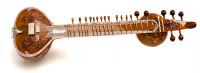 In appearance Sitar is very much similar to Tambura. The body of Sitar is
more or less spherical gourd at the lower end. The gourd is almost flat, like
In appearance Sitar is very much similar to Tambura. The body of Sitar is
more or less spherical gourd at the lower end. The gourd is almost flat, like
The finger-board of the Sitar is about three feet long and three inches wide,
hollow and deeply concave, covered with a thin piece of wood. There are sixteen
to twenty-two slightly curved frets of brass or silver which are secured to
the finger-board by pieces of gut.
The Sitar originally had only three strings, but the modern one's has a total
number of seven strings which are fastened to pegs on the neck and the sides.
These include the side strings (Chikari). Side strings are used both for the
drone and rhythmic accompaniment.
There are eleven or twelve sympathetic strings (Tarab) which runs almost
parallel to the main strings under the frets. These tarabs are secured to
small pegs fixed at the side of the finger-board. These strings are tuned
to produce the scale of the melody.
The Sitar is played by means of wire plectrum (Mizrab) worn on the forefinger
of the right hand. All the styles peculiar to instrumental music namely; alap,
jod, meend etc. can be played on this instrument with marked effect. Artists
such as Ravi Shankar
have made this instrument well known around the world.