|
|

Thursday, September 10, 2026
|
|


| Music Home » Musical Instruments |
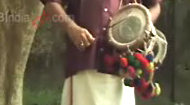
Edakka is an hour glass shaped drum, traditionally used as a part of the Panchavadyam, an instrumental music art form of Kerala, which accompanies some of the temple and church festivals. Played with a stick, this drum made with wood is considered to be a very auspicious instrument (in Malayalam - Devavadyam). During Pooja's in Kerala temples, it is the custom to play the Edakka as an accompaniment to singing, near the sanctum sanctorum.
 Similar to 'Damaru' another percussion instrument which is
found throughout India, Edakka is an indispensable accompaniment for Kerala
dance forms like 'Mohinayattam,
Kathakali
and Krishnanattam.
In Kathakali, the Edakka is played when a female character holds the stage,
when the Chenda is not played. In 'Koodiyattam'
also Edakka gives good support to the Mizhavu
(the pot drum).
Similar to 'Damaru' another percussion instrument which is
found throughout India, Edakka is an indispensable accompaniment for Kerala
dance forms like 'Mohinayattam,
Kathakali
and Krishnanattam.
In Kathakali, the Edakka is played when a female character holds the stage,
when the Chenda is not played. In 'Koodiyattam'
also Edakka gives good support to the Mizhavu
(the pot drum).
The legend behind this instrument is that Lord Shiva himself gave this instrument to Banasura, an ardent devotee of Lord Shiva. Therefore the instrument is considered sacred.
The different parts of the Edakka are 'Kutti' (main body made of wood), 'Vattom' - on either side made from the soft calf skin or Ulluri, depicts the sun and the moon. 'Tholkacha' (Kacha) the cloth slung over the left shoulder and the strings from which hangs the idakka and 'Jeevakol' ( there are 4 jeevakol in idakka, depicting the 4 vedas). From the jeevakol hangs 8 koduppukal on each side. 64 koduppukal from the 4 jeevakol depicts the 64 art forms. Vattom has 6 small holes depicting the six Shastras.
Both sides of the idakka is covered with vattom. The Edakka player suspends the idakka from his shoulder so that it hangs more or less vertically, simultaneously beating the drum with a stick held by the right hand. The left hand is used for tightening and loosening the tape wound round the middle. Varying the tension of the tape produces pitch changes. Simple melodies extending over one octave can be played in this instrument.
Artists |
|
| • | Tripunithura
Krishnadas |
|


