|
|

Saturday, August 29, 2026
|
|


|
|||||||||
|
|||||||||
| Onam |
|||||||||
|
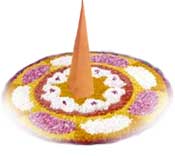
The celebration of Onam is a tribute to Mahabali's sacrifice. Onam celebrations which last ten days begin with a colourful reception to King Mahabali. Mahabali is supposed to visit his kingdom on the 2nd day, which is the most important day of the festival. Earthen mounds, which look somewhat like square pyramids, representing Mahabali and Vishnu are placed in the dung-plastered courtyards and beautifully decorated with flowers. The legend is believed to have happened at Trikkakara, a place 10km from Cochin on the Edapally- Pookattupadi road which according to mythology was the legendary capital of King Mahabali. The Vamanamoorthy temple here with the deity of 'Trikkakara Appan' or 'Vamanamurthy' is Lord Vishnu himself in disguise. There is another Vamana Temple in Thivikramangalam (Thamalam) near Thiruvananthapuram on the banks of Karamana River called 'Thrivikramangalam Maha Vishnu Temple'. Here Lord Mahavishnu idol is that of Vamana standing on top of the three worlds which is nearly 6 ft tall. Along with the main Vamana Idol, there are other deities (upa devathas) of Ganapathy, Ayyappan, Siva and Nagaraja. Built in the 8th Century AD, the temple is governed by the Travancore Devaswam Board and the annual temple festival (Utsavam) is in March-April.
After traditional prayers and worship the head of the household presents new clothes to the family and friends. There will be variety of entertainments like dances, sports etc. The festival lasts at least for four days. In many parts it goes beyond that period and occupies 6-8 or even 10 days. It commences practically from the asterism 'Atham' which comes on ten days before the asterism Onam or Thiru Onam. Atham is enjoyed as a holy day. The younger generation keep up the mirth and jollity which sets foot on this day till the end of the festival. The elders join them only on the last four days. The children of the village, assemble early morning and set about collecting flowers to decorate the yards of their houses for the ten days from Atham to Thiruvonam.. The chief decoration, 'onapookalam', consists of a carpet made out of the gathered
The important part of the festival opened in some localities on Tiru Onam day and in others on the day previous known as Utradam, 9th day from the Atham day. The houses are well cleaned and made to look nice and spruce and food-stuffs for a sumptuous feast are arranged. Even the poorest of the poor manage to find something for himself to celebrate the national festival in his own humble way.
The Onam celebrations open early in the morning of the Tiru Onam day, at about 4 or 5 a.m. In front of the yard of the house, a portion is cleaned and smeared with cow-dung. After this, Conical figures made of sticky clay painted red are placed there. These images are of various forms. Some represent figures of divinities, others are mere cones. The latter are known as 'Trikkakara Appan'. The tradition is that the festival had its origin at Trikkakara, a place 10km from Cochin which according to mythology was the legendary capital of King Mahabali. The temple there is the only temple in Kerala with the deity of 'Trikkakara Appan' or Vamana murthy who is Lord Vishnu himself in disguise. These images are adorned with lines tastefully drawn along and about with rice flour mixed with water. They are kept only in the front yard, but also in all prominent places commencing from inside the house and ending with the gate way outside. Flowers are strewn all along and Pujas performed to the images every day morning and evening. The first day Puja, is an elaborate one. One of the inmates of the house act the part of a priest. He bathes in the morning before dawn and prepares ata. Ata is a preparation of rice flour and molasses for 'Nivedyam' - offering for the god. Lamps are lit in front of the image and the Pujari proceeds his Puja in the presence of the family assembled in the yards. The Ata is placed in front of the images and he offers it to them. He strews flowers, pours water, shows certain signs with his fingers, puts on a solemn air and closes the ceremony. After the dedication of the images, the male members raise loud rhythmic shouts of joy. This is known as 'Aarppu Vilikkukal'. By this, they proclaim to the outside world that the great national festival of the Malayalis has commenced. As the day dawns, the inmates of the house, bathe and worship in the village temple. They put on their finest clothes. The most-distinguishing feature of the Onam festival is the distribution of new clothes as presents. The 'Karanavar', the eldest member of the Tarawad gives these presents to the juniors, the servants and the dependants of the family and others. The junior members also sometimes give such presents to their relatives. After the distribution of presents, then comes the feasting. The most prominent place in the house is selected and all the members of the family sit in row, with the Karanavar in the middle of the line. A bright shining lighted brass lamp is placed in front of the Karanavar at a slight distance. In front of the lamp, towards the west, a small plantain leaf is spread with its point towards the lamp. Food is served in it. This is supposed to be for the God Ganapathy to partake. The tenants of the family, dependants and hangers-on present themselves before the Karanavar the day previous to Tiru Onam with the fruits of their labour, such as vegetables of divers sorts, coconut oil, plantains, pumpkins, cucumbers, brinjal etc. This is called 'Onakazhcha'. In return for this, the tenants have to be given a sumptuous feast on one of the Onam days before the festival terminates. Every village artisan will present the Karanavar of each Nayar Tarawad, a specimen of his handiwork. These are graciously received and other presents of cloth or rice and curry stuffs are given in return. |
|||||||||
|
|
|||||||||
|
|||||||||||||||||
|
|||||||||||||||||
| Last Updated on : 30 May 2025 | |||||||||||||||||


 Onam
is the national festival of the people of Kerala. It is the festival of
flowers, which falls in 'Chingam' or Bhadrapada usually in August or September.
It is a harvest festival and goes for 4 colourful days with song and Kathakali
dances, feasting and boat races.
Onam
is the national festival of the people of Kerala. It is the festival of
flowers, which falls in 'Chingam' or Bhadrapada usually in August or September.
It is a harvest festival and goes for 4 colourful days with song and Kathakali
dances, feasting and boat races. 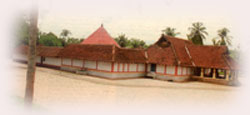

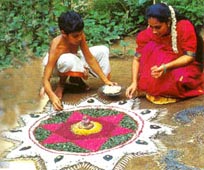 native
blossoms like Thumba (common leucas), Kakka poovu, Thechipoovu, mukkutti (little
tree plant), chemparathy (shoe flower), aripoo or Konginipoo (lantana), hanuman
kireedom (red pagoda plant), chethi (ixora) etc. The large flowers, and one or two
varieties of foliage of differing tints are pinched up into little pieces to
serve the decorator's purpose. There were specifications of the type of flowers
to be used on each of the ten days from 'Atham' to 'Thiruvonam'. This flower carpet is invariably made in the
centre of the clean strip of the yard in front of the house. It is a
beautiful work of art accomplished with a delicate touch and a highly artistic
sense of tone and blending. When the carpet is completed, a miniature pandal,
hung with little festoons used to be erected over it. Now the traditional 'pookkalams'
with flowers collected from the vicinities are becoming a thing of the past and
today in the cities several Pookkalam competitions are being floated during Onam.
native
blossoms like Thumba (common leucas), Kakka poovu, Thechipoovu, mukkutti (little
tree plant), chemparathy (shoe flower), aripoo or Konginipoo (lantana), hanuman
kireedom (red pagoda plant), chethi (ixora) etc. The large flowers, and one or two
varieties of foliage of differing tints are pinched up into little pieces to
serve the decorator's purpose. There were specifications of the type of flowers
to be used on each of the ten days from 'Atham' to 'Thiruvonam'. This flower carpet is invariably made in the
centre of the clean strip of the yard in front of the house. It is a
beautiful work of art accomplished with a delicate touch and a highly artistic
sense of tone and blending. When the carpet is completed, a miniature pandal,
hung with little festoons used to be erected over it. Now the traditional 'pookkalams'
with flowers collected from the vicinities are becoming a thing of the past and
today in the cities several Pookkalam competitions are being floated during Onam. 


