| Teyyam
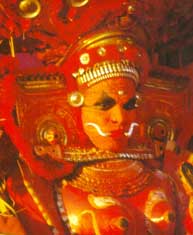 Teyyam is a ritualistic dance with its rare and grotesque make-up and
costume, lively foot work, gymnastic fervour and ritualistic vitality.
Teyyam represents a glorious period of folk life in Kerala and the souls
of the dead heroes of the land and the gods and goddesses are supposed
to come in our midst through the medium of the possessed dancers and converse
with us on matters of even contemporary significance. It is the worship
of spirits by invoking them to the mortal body of the dancer who impersonates
them and gives blessing to the believers. Teyyam evolves from Kaliyattam
practiced by aboriginal tribes of northern regions of the state. Kaliyattam
is an annual festival attached to the shrines known by the names like
muchilod, kavu, palliyara, mundya, tanam, madhapura all in the districts
of Cannanore.
Teyyam is a ritualistic dance with its rare and grotesque make-up and
costume, lively foot work, gymnastic fervour and ritualistic vitality.
Teyyam represents a glorious period of folk life in Kerala and the souls
of the dead heroes of the land and the gods and goddesses are supposed
to come in our midst through the medium of the possessed dancers and converse
with us on matters of even contemporary significance. It is the worship
of spirits by invoking them to the mortal body of the dancer who impersonates
them and gives blessing to the believers. Teyyam evolves from Kaliyattam
practiced by aboriginal tribes of northern regions of the state. Kaliyattam
is an annual festival attached to the shrines known by the names like
muchilod, kavu, palliyara, mundya, tanam, madhapura all in the districts
of Cannanore.
The performer belongs to Mannan, Velan and Malayan communities.
The landlords and chieftains encouraged these artists and introduced many
improvements by initiating new themes into its fold and classified them
to appropriate communities for their propagation. Titles like Peruvanaan,
Perumalayan were the best among them. These spirits continue to be propitiated
through generations. They belong to different categories based on their
appearance and character.
During epidemics, the whole community join hands in
making the offering of the ritual to the presiding spirit of such calamities
and appease them. There are several presiding goddesses like Kali, Chamundi,
Bhagavati all manifestations of Shakti or supreme power and gods like
Bhairavan, Gulikan, Vishnumurthy, Pottan representing the Shaivite and
Vaishnavate concepts and animal spirits form another class comprising
Bali, Hanuman, Puli. Teyyam dance is done as an offering for begetting
children, winning of law suits, warding of evils, getting rid of epidemics
and for similar successful culmination of individual and social desires.
Teyyam is essentially a human creation. It has absolute
relationship with man in giving vent to his strong feelings against injustice
and wickedness and his desire to maintain the well-being of society. It
shows how the primitive man transforms his life experience into metaphysical
thoughts through rites and rituals and identifies his abstract visions
in a concrete design, attributing multiple forms to them.
The headgear or the mask made of materials from nature
and painted with natural colours in Teyyam assumes a grotesque and archetypal
image with the blending of highly artistic and emotive display. Man willingly
offers himself to be subdued by his mystic attainments. It is his own
re-creation of the abstract experiences handed down to him by generations,
the secular side gives him the rationale based on practice and observations.
A socially known theme of love, like one depicted in
the famous Teyyam 'Katiranur Viran' gives a very concrete picture of an
extremely abstract emotional content. The theme is recreated with its
mythical and ritualistic imagination and the dancer went to the moods
through his body postures, movements and articulation. The performer becomes
possessed in this act of impersonation of the dead hero or the godly spirit,
it does not leave him in totally unconscious state, on the contrary he
would meticulously cling on to the rhythm a technique of mechanical perfection
even when he is out of his normal mood.
|



