Kidneys & Related Diseases
 Kidneys
are two small bean shaped organs, each about the size of the fist, located on
either side of the spine just above the waist at the small of the back. It is
a part of the urinary system. Each
kidney
is about 10cm long, 5-6cm wide, 2.5cm
thick and weighs between 115 to 170g in the adult human. The right kidney is
situated slightly lower than the left because the liver pushes it down.
Kidneys
are two small bean shaped organs, each about the size of the fist, located on
either side of the spine just above the waist at the small of the back. It is
a part of the urinary system. Each
kidney
is about 10cm long, 5-6cm wide, 2.5cm
thick and weighs between 115 to 170g in the adult human. The right kidney is
situated slightly lower than the left because the liver pushes it down.
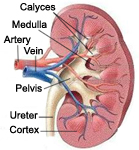
The outer portion of the kidney called cortex is composed of
blood vessels and urine tubes and is supported by a fibrous matrix. Deep to
the cortex lies the medulla which is divided into 10-20 conical regions called
renal pyramids. Renal pyramids also known as the malphighian pyramids contains
the secreting apparatus and tubules. Each pyramid together with the associated
overlying cortex forms a renal lobe.
The
tip of each pyramid (called a papilla) empties into a calyx, which empties into
the renal pelvis. Pelvis forms a small reservoir for urine produced by the kidney.
The whole kidney is covered by a membrane called renal capsule.
The cortex and the medulla are made up of nephrons, which is
the most basic functional units of the kidney and each kidney contains about
a millions of nephrons. Filtration, re-absorption and secretion of the blood
occurs in the nephron. Each nephron is made of a glomerulus and a tubule. The
glomerulus is like a miniature filtering or sieving device while the tubule
is a tiny tube like structure attached to the glomerulus.
Note : All statements given are only for information purpose. We are not responsible or liable for any problems related to the utilization of information on this site. We suggest that you consult a qualified doctor before trying any alternative health care remedies.



