You are in : GARDENING » FLOWERING PLANTS » ORCHIDS » Miltonia
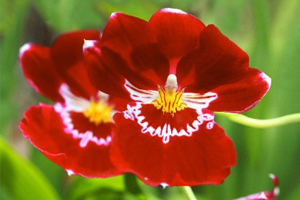
Miltonia
| Scientific Name : Miltonia spectabilis Lindl |
| Family : Orchidaceae |
| Colour : Red, white, pink, yellow |
| Common names : Pansy Orchid |
| |
Miltonia's are
sometimes called the Pansy Orchid because their flat-faced, open flowers
resemble pansies in shape and markings. They are named in honour of Earl Fitzwilliam and
Viscount Milton. Growers have divided the
Pansy orchids into two groups, Miltonia and Miltoniopsis. Miltonias are warm-growing orchids
which come from Brazil and Miltoniopsis, come from Columbia,
are moderate temperature growers from the foothills. These charming irresistible
plants bloom profusely. The richly colored, fragrant flowers are borne on
slender arching stems and can reach to sizes of 2-3 inches in width. Flowers
vary in colors - Red, white, pink with different colored markings and yellow. Although they may last for up to a month,
their bloom time is as short as that of a cut flower.
Miltonias may be a little difficult to grow,
but if necessary temperature and lighting
requirements are provided, they can be grown in the home or greenhouse. Miltonia's like an open compost that does not hold
excessive amounts of water. It prefers tree-fern fibre mixed with perlite and
bark composts. The day temperature for Miltoniopsis type is 85°F, while the night
temperature is 50 to 60°F. For Miltonias, day temperature is 70 to 85°F
and night temperatures 55to 65°F.
Miltonia grow throughout the entire
year and must be kept evenly moist. Depending upon the temperature, Miltonias
should be watered twice a week. Water carefully and do not allow water to stand
in the leaves or soft rot may occur. Miltonia enjoy moist air, requiring a
minimum of 55 to 65% humidity. An increase in humidity is needed to reduce the
stress on the plants when the temperature and lighting intensity increases.
Miltonias must be fertilized on a regular basis. Fertilize approximately twice
per month when new growth is developing. They should be fed regularly with half-strength nitrogenous
fertilizer.
The leaves on the miltonia plant should be light green.
If the leaves are dark green, increase lighting. If the leaves turn yellowish
green or reddish, increase shading. Repot the miltonias at least once every 2
years or when the potting medium begins to decay. Common pests associated with
Miltonias are scale, spider mites and aphids. X-Clude, an encapsulated pyrethrum
time-release insecticide, and Neem Oil are the most efficient methods of pest
control.
Questions of
Questions & Answers |
|
| 1. |
Posted on :
2.9.2013 By : Shaleen Chikara , Gurgaon, NCR
|
View Answer (0)
|
Post Answer
|
|
| |
I am growing an Orchid in a small pot filled with charcoal (that's how it came). It was flowering when it came, and now I see 3 new shoots emerging from the sides. How should I care for it and how much should I water it? Also, what is a good potting medium?
I am living in Delhi, and currently it is monsoon season, but soon dry winters will set in. |
|
|
|
|
| 2. |
Posted on :
24.1.2011 By : shruthi , bangalore
|
View Answer (2)
|
Post Answer
|
|
| |
few of my phaelanopsis orchids started to loose the topmost leaf(the blooms were present) and eventually all the leaves fell off.The roots are fine,not dry totally but will the plant grow back? what could be the problem and what do i do? |
|
|
| A1: |
As long as the bulbs are still there and not rotten, it will still grow but takes time to wait for new leaves. |
| |
Posted By :grace de la pena , Cagayan de Oro City, Mindanao | On 9.5.2013 |
|
| A2: |
water got into the center of the plant and rotted must water from the bottom and keep tops dry and no it wont grow back |
| |
Posted By :kevin , las vegas | On 22.2.2011 |
|
|
|
|
| 3. |
Posted on :
5.9.2010 By : Maxine , Spring Hill. Fl, Spring Hill. Fl
|
View Answer (1)
|
Post Answer
|
|
| |
I separated my ground orchid, Spathoglottis plicata this spring as it was over crowed and it has not shown any sige of blooming, What so I need to do to encourage blooming? |
|
|
| A1: |
Hi. I had the same problem. However, I solved it with a bi-weekly watering of a small orchid fertilizer (literally 1/8 of a teaspoon). The water itself was taken from my patio pond. I placed the plant in a high humidity area near other plants. Let the plants drain out completely between waterings. The soil mix comprised real, finely chopped coconut bark, crushed egg shells, charcoal, phosphorus, lumus soil - basically nothing compact. Watch out for mealy bugs as they love these plants. |
| |
Posted By :Paulos , Trinidad | On 15.7.2016 |
|
|
|
|
| » more... |