Kathakali - Stage And Performance
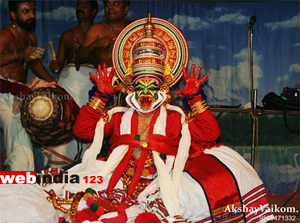 Kathakali is performed in open air on a roughly 5 metre square stage in a
temple compound or a courtyard of someone. The stage is generally covered
with coarse mats. A tall and massive brass lamp fed with coconut oil is set
Kathakali is performed in open air on a roughly 5 metre square stage in a
temple compound or a courtyard of someone. The stage is generally covered
with coarse mats. A tall and massive brass lamp fed with coconut oil is set
This is the only lighting
used. The lamp itself as a point of gravitation, assumes a distinct personality
of its own with its two flames sometimes prancing and leaping and now flickering.
The lamp has two wicks, the thicker one facing the stage and the other one
facing the spectators.
The continuous thundering of the
drum called Chenda heralds the performance of Kathakali. Chenda is a typical
drum which is played on one side only by beating it with two sticks slightly
upturned at the ends. It is a percussion instrument with a very loud and piercing
sound. There is another drum called Madala which is played on both sides simultaneously
with hands. There are also large bronze cymbals. All these three are played
in unison to proclaim the performance. This skilled and captivating drumming
is known as Melappadam.
Then
follows the pure Madala, that is drumming on the Madala alone for sometime.
Then there is Mangalacharan and invocation of the gods for blessings and successful
completion of the performance. It is followed by the appearance of two men holding
a rectangular curtain made up of numerous bright and deep coloured silken
pieces, richly designed and embroidered. Two dancers perform a devotional dance
behind the curtain. The dance is of pure type and is called Todayam. The curtain
is lowered half way, showing the two dancers who are of noble class. With the
louder drumming they perform a captivating dance and the curtain is removed
to all accompaniment of sounding a conch shell.
After the todayam comes a pure nritta
piece known as the purappadu, in which appear two characters either the hero
or his consort or two other pachcha characters or even the five Pandava brothers.
The purappadu is another introductory dance of invocation and has no mime. The
dancer presents a number of pure dance sequences (Kalasams). The entire technique
of Kathakali is exhibited through these cadences. After the purappadu, the play
or the particular scene of the play chosen for the evening begins.
Before any major character appears,
there is the slow revelation of the character from behind the curtain. The character
gradually appears as the curtain is lowered. When a powerful character appears
for the first time, he stands close behind the curtain and there appears to
be a struggle between the character and the curtain. To the accompaniment of
the drums and cymbals, the character executes many dance sequences which are
only partially seen by the audience. The curiosity of the audience increases
and the suspense is maintained. As if the power of the character were conquering
the curtain or vanquishing the stage attendants, the curtain disappears and
he appears in his full glory. The play with the curtain is known as the
tiranokku.
Beyond this point the story unfolds
through nritta, natya and abhinaya. The passages contain soliloquies of characters
or are sometimes highly descriptive to enable the actor to present abhinaya.
Sometimes, they consist of key words which can give the dancer full opportunity
for presenting variations (sancharibhava) and sometimes, there are passages
of court drama and dialogue on which dramatic climax is built up. The passages
sung are interspersed with purely percussive musical accompaniment. Thus after
a padam has been sung and the abhinaya has been done, the singer stops while
the actor goes on to interpret the literary content through gestures to the
accompaniment of the percussion instruments. This interpretation is known as
the manodharma which affords the actor full scope to improvise. During the manodharma
an imaginative and well-trained actor can hold an audience over one sequence
for hours. This is followed by pure nritta passages where only the kalasams
or the dance cadences are executed.
As the play concludes the curtain is reintroduced and the players behind it
make their exit almost exhausted but fully satisfied having played and danced
their roles with great confidence, composure, poise, aplomb, virtuosity and
eclat.



