| 
Kalari
 Kalari is a martial art form of Kerala. The origin of the Dravidian word
'Kalari' itself is doubtful, as to whether it is derived from the Sanskrit
word 'Khalurika' or vice versa. The word literally means - a parade place
for military exercises. It is used to mean both military training centre
and a place for acquisition of knowledge. 'Kalari' also means an assembly
or a business place or a temple where the family deity presides. 'Payatt'
means practice or exercise.
Kalari is a martial art form of Kerala. The origin of the Dravidian word
'Kalari' itself is doubtful, as to whether it is derived from the Sanskrit
word 'Khalurika' or vice versa. The word literally means - a parade place
for military exercises. It is used to mean both military training centre
and a place for acquisition of knowledge. 'Kalari' also means an assembly
or a business place or a temple where the family deity presides. 'Payatt'
means practice or exercise.
Kalari Payattu is a traditional style of combat and has no accompanying
instruments to punctuate its movements. The locomotion and bodily throws
and thrusts of the practitioner are done according to verbal instructions
of the teacher (Gurukkal) which are articulated in the mould of a special
rhythm. Kalari is responsible mainly for the stronger elements of Kerala's
dance and culture. Kalari practices gives to any dancer, female or male,
proper grounding for developing skill and flexibility of the body. The
basic stance of Kathakali resembles that of Kalari very much. The 'Chuzhippu'
in Kathakali has directly sprung from the 'Vadivu' in Kalari. A 'Vadivu'
starts with a static pose which later gets charged with movement. Gaja
(elephant), Aswa (horse), Kukkuta (cock), Marjara (cat), Narasimha (half
lion and half man - Vishnu's incarnation), Matsya (fish) and Sarpa (snake)
are poses which a student of Kalari practices as a part of his offence
and defence exercises. The 'tandava' type of movement in Kalari is developed
from the tradition comprising various group and individual martial forms
inherited from the tribal society. One of the peculiarities of the concept
of movement in the Kalari system is that it is conceived as a kind of
expression of an inner urge or 'bhava'. The term 'Sarirabhava' generally
used in Kalari rightly emphasises this point and it has great relevance
to Indian concept of acting. The four components of Kalari are angika,
aharyya, vachika and satvika; though the practice of 'Sarirabhava' teaches
the rudimentary lessons of the combination of angika and satvika.
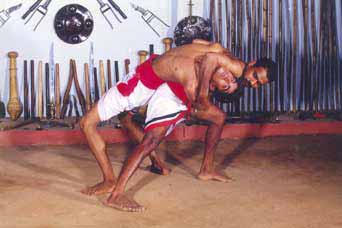 Kalari
culture is known to Kerala from pre historic days. There are two distinct
styles of Kalari Payattu, the Northern and the Southern style. There were
Kalaris belonging to many communities of Dravidian origin like Pulaya
and Parayas. In earlier days Kalari was not only a place to impart physical
training but also languages, arts and science. Later due to internal strife
between the various chieftains in different principalities in Kerala,
Kalari gradually became centre's used to maintain a small army of
fighters to deal with the constant warfare between the chieftains. There
was a developed system of medicine, practiced in all Kalaris and this
formed a branch of Ayurveda. This system of medicine known as 'Kalari
Marma Chikitsa' has earned wide popularity. Chanting of mantras without
sound were also done in Kalari's for the concentration of the mind. Now
the mantras have gone out of use and Kalari is only practiced as a means
of physical exercise and medicine. Kalari
culture is known to Kerala from pre historic days. There are two distinct
styles of Kalari Payattu, the Northern and the Southern style. There were
Kalaris belonging to many communities of Dravidian origin like Pulaya
and Parayas. In earlier days Kalari was not only a place to impart physical
training but also languages, arts and science. Later due to internal strife
between the various chieftains in different principalities in Kerala,
Kalari gradually became centre's used to maintain a small army of
fighters to deal with the constant warfare between the chieftains. There
was a developed system of medicine, practiced in all Kalaris and this
formed a branch of Ayurveda. This system of medicine known as 'Kalari
Marma Chikitsa' has earned wide popularity. Chanting of mantras without
sound were also done in Kalari's for the concentration of the mind. Now
the mantras have gone out of use and Kalari is only practiced as a means
of physical exercise and medicine.
There are a few Kalari institutions and individual gurus
engaged in continuing this system in this pristine form. Among them, E.N.S
Kalari (Phone :91- 484-2700810), C.V.N Kalari etc are leading institutions.
The late Sri C.V Narayanan Nair Gurukkal (in whose memory the C.V.N Kalari
has been established), his son Gurukkal C.V Govindankutty Nair, E.N.Sreepathy
Embranthiri Gurukkal, the late Sri. Sridharan Nair of Chirakkal, are some
of the prominent names in the field of Kalari.
|